

Aquamarine vs. Blue Topaz, What are the Differences?
In the world of high jewelry, blue has always symbolized tranquility, depth, and eternity. When you're trying to find the perfect blue gemstone, aquamarine and blue topaz are often the two most talked-about and visually similar candidates. Among all blue gemstones, aquamarine and blue topaz are the two most easily confused. But they differ dramatically in rarity, physical properties, market value, and symbolic meaning.
This article will break down the differences between aquamarine and blue topaz in depth. Whether you’re looking for a unique aquamarine engagement ring or a cost-effective birthday gift, this comprehensive guide will help you make the most informed decision.
What is Aquamarine?
The name "aquamarine" comes directly from Latin, meaning "sea water" (aqua = water, marina = sea), which perfectly describes the gem’s transparent, flowing, wave-like blue appearance.
Aquamarine belongs to the beryl family, which means it’s a close relative of the costly emerald and the elegant morganite. Its chemical composition is beryllium aluminum silicate (Be₃Al₂Si₆O₁₈), and its characteristic blue color comes from trace amounts of divalent iron (Fe²⁺) in the crystal structure—the more iron present, the deeper the blue saturation.
Color and Clarity Characteristics
Aquamarine’s color ranges from pale blue and sky blue to deep sea blue. The most sought-after colors in the market are the richly saturated "Santa Maria Blue" and the "Madagascar Blue" from Africa. Generally, the deeper the color, the higher the value.
In terms of clarity, aquamarine typically exhibits very high transparency with relatively few inclusions, which is one reason it’s renowned in the gem world for its "purity." Compared to emeralds, aquamarine crystals usually have better clarity, and inclusions are often hard to see with the naked eye.
Origin and Formation
The world’s most important aquamarine deposits are concentrated in Minas Gerais, Brazil—gems from there are known for deep color and excellent clarity and are considered top-tier globally. Other major sources include:
Madagascar and Mozambique (African deposits with high color saturation); Nigeria and Zambia (stones with deeper blue tones that have attracted increasing market attention in recent years); Afghanistan and Pakistan (aquamarines with greenish hues that are highly collectible); and Xinjiang, China (clearer tones, typically smaller sizes).
Aquamarine forms in granitic pegmatites and requires hundreds of millions of years of geological processes to crystallize. Crystals can reach enormous sizes—the largest historic aquamarine rough, "Dom Pedro," weighed 26 kilograms and is currently exhibited at the Smithsonian National Museum of Natural History.
Cultural and Historical Significance
Aquamarine has long-held symbolic significance in human civilization. Ancient Roman sailors carried aquamarine, believing it would protect them on voyages; medieval Europe regarded it as a symbol of fidelity and eternal love; and in modern jewelry design, it is beloved by designers for its clear, unpretentious elegance.
What is Blue Topaz?
Blue topaz belongs to the topaz mineral family; its chemical composition is a fluorine-containing aluminum silicate (Al₂SiO₄(F,OH)₂). Topaz is naturally colorless in many cases; its color comes from trace elements like chromium and iron in the crystal and from lattice defects (color centers).
Natural blue topaz is extremely rare. Most blue topaz on the market has been treated by irradiation plus heat treatment (annealing) to turn naturally colorless or pale topaz into blue. This treatment is a fully legal, widely disclosed industry-standard process.
Commercial color grades of blue topaz on the market:
- Sky Blue Topaz is the lightest grade, showing a delicate pale blue similar to a clear daytime sky. It’s the most affordable and the mainstream choice for entry-level blue topaz.
- Swiss Blue Topaz is a mid-depth, vivid blue with high color saturation and strong visual impact. It’s currently the best-selling type of blue topaz on the market and offers excellent value.
- London Blue Topaz is the deepest grade, showing a dark blue with gray or green undertones. Its color is mysterious and understated; it has become very popular in recent years and is widely used in high-end jewelry. It is also the most expensive of the three.
Sources and Characteristics
The main source of the raw material for blue topaz (colorless topaz) is Brazil, Sri Lanka, Pakistan, Russia, and China. After treatment, the color is generally stable, but note: long-term exposure to strong ultraviolet light can cause slight fading, so blue topaz jewelry should not be left in prolonged direct sunlight.
Cultural and Symbolic meaning
Blue topaz is a birthstone for November (shared with yellow topaz) and is also recognized by some standards as a December birthstone (modern gemological standards vary). It symbolizes friendship, loyalty, and deepening emotions, and in Western tradition it is thought to enhance communication and self-expression.
Differences Between Aquamarine and Blue Topaz
With the basic appearances understood, let’s get to the core comparison.
1. Aquamarine Vs. Blue Topaz Color
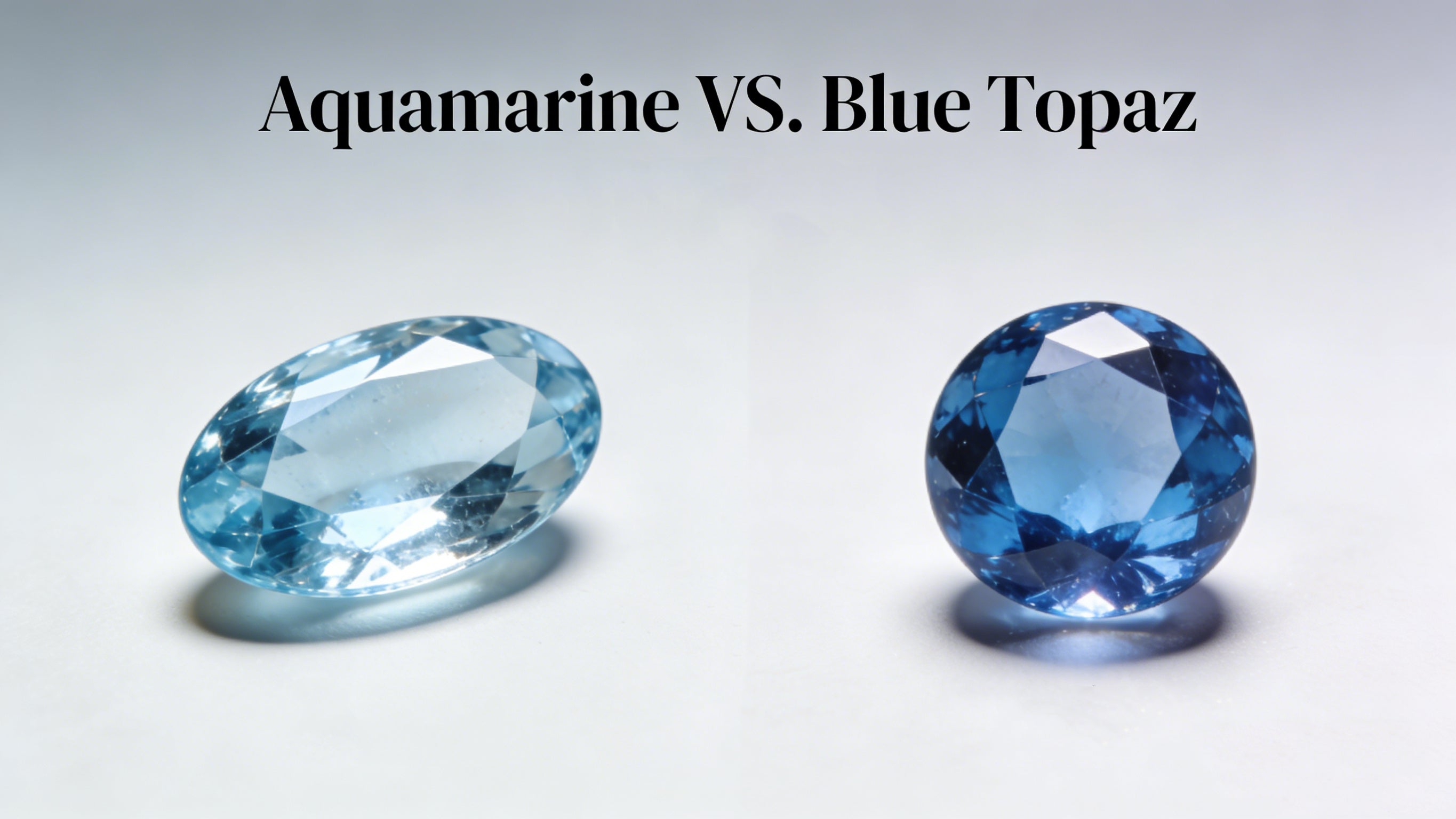
Aquamarine’s blue typically has a distinctive cyan or slightly greenish tint. Its color is softer, more natural in transition, and richer in depth, giving a sense of serene profundity—like looking into the deep sea. High-quality aquamarines, such as the famous Santa Maria tone, are deep yet retain a translucent clarity. They resemble a pool of moving seawater; their color feels lively and layered.
Deep blue topaz is rare in nature. Most blue topaz on the market is produced by neutron or electron irradiation followed by heat treatment. This process makes the topaz’s blue purer, more vivid, and more saturated.
- Sky Blue Topaz: shows a delicate pale blue, like a clear sky.
- London Blue Topaz: has a deep, cool dark blue-gray or dark blue-green tone.
- Swiss Blue Topaz: extremely high saturation—almost a perfect pure blue with a near “electric” brightness.
These colors often look too perfect and lack the “natural narrative” that aquamarine shows because of natural inclusions and uneven distribution of trace elements.
A simple way to remember: if aquamarine’s blue is the "ocean", then blue topaz’s blue is the "sky" (Sky Blue) or a "lake" (Swiss Blue)—visually more direct and striking.
2. Aquamarine Vs. Blue Topaz Rarity
Rarity is the core indicator of a gemstone’s investment value.
Aquamarine falls into the mid-to-high rarity category. High-quality specimens with deep color, high clarity, and large carat weight are relatively scarce on the market. As top mining areas (such as the Santa Maria de Itabira mine in Brazil) become depleted, the potential for high-quality aquamarine to retain or even increase in value is becoming more apparent.
Blue topaz is less rare. Raw materials are abundant, treatment methods are mature, and market supply is large, so it generally lacks notable investment or collectible value. However, as everyday-wear jewelry it offers excellent cost performance.
3. Aquamarine Vs. Blue Topaz Price
Rarity and value tend to correlate. In terms of price, high-quality aquamarine typically sells for $50 to $500 per carat, and top-tier deep-colored aquamarine (Santa Maria blue) can exceed $1,000 per carat. Aquamarine prices increase exponentially with carat weight. Large, high-quality aquamarines over 10 carats are highly sought after in the collectors’ market.
By contrast, blue topaz is much more affordable. Sky blue and Swiss blue topaz usually cost only $5 to $30 per carat, and even high-quality London blue topaz rarely exceeds $80 per carat.
Aquamarine is considered a “precious gemstone”, while blue topaz is generally classified as a “semi-precious gemstone”. The price of a high-quality 5-carat aquamarine can be 20–50 times that of a blue topaz of the same size.
The fundamental reason for the price gap: aquamarine forms naturally and is rare (often untreated or only heat-treated), whereas blue topaz typically requires artificial irradiation to achieve its blue color and the raw material (colorless topaz) is relatively abundant. This does not mean blue topaz is “inferior”—it simply reflects differences in scarcity.
4. Aquamarine Vs. Blue Topaz Hardness and Durability
On the Mohs scale, aquamarine has a hardness of 7.5–8, while blue topaz rates about 8—so there’s little difference, and both are hard gemstones suitable for daily wear.
Although aquamarine is slightly softer than topaz, aquamarine lacks cleavage, whereas blue topaz has perfect basal cleavage. This is similar to the grain in wood: a strong impact at a particular angle can cause the gem to split along a horizontal plane.
For high-frequency daily-wear items like engagement rings and jewelry, aquamarine actually performs better than blue topaz over the long term in terms of impact resistance.
5. Aquamarine Vs. Blue Topaz Density and Size
In gemology, specific gravity determines the volume of a gem at a given weight. Aquamarine’s specific gravity is about 2.68–2.80, while blue topaz’s is about 3.49–3.57. That means a 1-carat aquamarine will look roughly 20%–25% larger than a 1-carat blue topaz. Aquamarine can deliver a more visually impressive size for a lighter weight compared with blue topaz.
6. Aquamarine Vs. Blue Topaz Optical Properties
A gem’s “sparkle” depends on how it refracts and reflects light. Aquamarine’s refractive index is about 1.577–1.583, giving it moderate brilliance and a characteristically clear, pure transparency. Under light, aquamarine displays a soft, restrained appearance—more like glass or satin luster than strong fire. This quality makes it especially well-suited to minimalist designs.
Blue topaz has a slightly higher refractive index, about 1.619–1.627, and typically shows stronger scintillation after cutting. Under strong light, blue topaz reflects more colorful flashes and appears more dazzling, appealing to those who prefer a more brilliant look.
7. Aquamarine Vs. Blue Topaz Birthstone Meaning
Aquamarine is the birthstone for March and is suitable as a gift for those born in March, symbolizing courage, tranquility, and a clear heart. It is also the gemstone associated with the 19th wedding anniversary, giving it special commemorative meaning for couples celebrating 19 years of marriage.
Blue topaz is the birthstone for November (and in some modern classifications, also for December). It makes a fitting gift for friends born in late autumn or early winter and symbolizes loyalty, friendship, and deep connection. It is also the traditional gemstone for the fourth wedding anniversary.
Blue Topaz Vs. Aquamarine, Which is Better for Jewelry?
Engagement Rings
If you’re considering a colored gemstone engagement ring instead of a diamond, aquamarine is the more recommendable choice. This is because:
- As a once-in-a-lifetime commitment, aquamarine’s rarity and sense of value better match the emotional weight and uniqueness an engagement gift should carry.
- Aquamarine’s hardness (7.5–8) and cleavage characteristics make it more durable and reliable for the daily wear typical of engagement rings.
- Aquamarine’s distinctive “ocean blue” has an irreplaceable visual identity. Its soft tones pair beautifully with platinum or 18K white gold, creating an elevated, ethereal elegance.
Blue topaz can also be used for engagement rings, but it’s advisable to choose the London Blue variety for its more restrained and sophisticated color. In terms of mounting design, opt for bezel settings or reinforced prongs to reduce cleavage risk.
Daily Wear
For everyday commuting and work jewelry, blue topaz’s high cost-effectiveness is a major advantage. With the same budget you can get a larger, better-cut blue topaz. If a blue topaz piece gets scratched or damaged, replacement costs are relatively low, so you won’t feel the same heartache as losing an aquamarine. Swiss Blue topaz’s bright color is also very versatile with everyday outfits.
Aquamarine is also excellent for daily wear. Its understated, refined temperament pairs especially well with professional attire, particularly when set as stud earrings or pendant necklaces—tasteful and not flashy.
Gift Giving
When choosing a gemstone as a gift, the most important reference points are the recipient’s birth month and your emotional budget.
Aquamarine jewelry is an unparalleled birthstone gift for someone born in March, matching both color and meaning. Blue topaz jewelry is the best gift for someone born in November, with symbolic significance that fits better. If your budget is limited but you want to give a quality blue gemstone, blue topaz (especially London Blue) is an excellent choice; if you want the gift to convey rarity and preciousness, aquamarine carries stronger value signaling.
How to Choose Between Aquamarine and Blue Topaz?
Faced with the shimmering aquamarine and the deep, brilliant blue topaz, you might find yourself stuck at the last moment. This isn’t just picking a stone—it’s defining the emotional undertone of a gift. To help you make a decision you won’t regret, LUO Jewelry has summarized the following five decision-making dimensions.
1. Assess Your Wearing Scenario and Purpose
If you’re choosing an engagement ring, we strongly recommend aquamarine, because marriage symbolizes uniqueness and preciousness. As a naturally occurring fine gemstone, aquamarine’s scarcity perfectly echoes the solemnity of “holding hands for life”.
In addition, aquamarine’s soft tones are easy to match with various wedding gowns and everyday clothing—its pale blue has been called the “bride’s lucky color”, fitting the Western tradition of “Something Blue”. Choosing a 2–3 carat, well-cut aquamarine engagement ring from LUO Jewelry can become a family heirloom.
If you’re looking for everyday fashion accessories or a reward for yourself, blue topaz is an excellent choice—modern women pursue versatile styling. Blue topaz (especially Swiss Blue or London Blue) is richly colored and eye-catching, instantly brightening a simple work suit or an elegant evening dress. Because it’s affordably priced, you can opt for a larger carat weight or bolder designs without worrying about budget overruns. If you choose blue topaz jewelry, LUO Jewelry recommends bezel settings or six-prong protective settings to reduce the risk of impacts to the stone’s edges.
2. Clarify Your Budget Range
When buying gemstone jewelry, it’s important to distinguish between “price-per-carat value” and “visual impact”.
If you value “bigness equals beauty”: If your budget is under $500 but you want a gem over 5 carats with a striking visual effect, blue topaz is your only practical choice. In the world of topaz you can easily achieve “jewelry freedom,” owning deeply saturated, intense blue stones.
If you value “rarity and investment”: If your budget is $500–$1,000 or more, prioritize aquamarine. In this price range you can find aquamarines with pure tones and excellent clarity. Although their carat weight may be smaller than topaz at the same price, being a member of the beryl family gives them higher recognition in the secondary market and among collectors.
3. Determine Your Skin Tone and Aesthetic Preference
Before choosing blue gemstone jewelry, ask yourself whether you prefer a “fresh, natural” look or a “deep, dramatic” style.
If you have cool undertones and favor a fresh, ethereal style, aquamarine is the best choice. It’s like a sunlit sea at dawn—transparent, cool, and often with refined gray or slight green undertones. Its aqua-blue is especially flattering on fair skin and gentle temperaments, giving a very ethereal look. At LUO Jewelry, customers who love Nordic or minimalist styles often fall in love with aquamarine jewelry at first sight.
If you have warm or deep skin tones and prefer a deep, modern look, blue topaz—especially London Blue topaz—resembles the Thames at night: mysterious, steady, and modern. Its high contrast works wonderfully for deeper complexions (which it can help brighten), for those seeking personal expression, or for wearers who want jewelry that projects a strong presence in social settings.
4. Understand Treatments
If you insist that “beauty must be the earth’s most original form”, and are okay with paler color or natural inclusions like rain-like internal features, choose aquamarine. It represents our reverence for nature’s millennia-long creations.
If you believe jewelry’s purpose is to “deliver the most beautiful visual effect” and don’t mind scientific irradiation or heat treatments, blue topaz will give you near-flawless saturation and clarity—qualities that are rare and expensive in completely natural gemstones.
Most blue topaz on the market has been irradiated; this is an industry standard, not deception. Aquamarines are often heat-treated to improve color, which is also an accepted routine practice. When shopping, ask jewelers for detailed information about treatments. Reputable jewelers will often disclose treatment information proactively.
5. Value Cut and Setting Design
Whichever blue gemstone you choose, the quality of the cut directly affects its optical performance. Round brilliant cuts are suited to those seeking sparkle; cushion or oval cuts maximize color depth; and emerald cuts (step cuts) best showcase aquamarine’s characteristic icy transparency.
6. Choose Trustworthy Buying Channels
Whether you choose aquamarine or blue topaz, require the seller to provide a gemstone identification report (recommended labs: GIA, GRS, IGI, or other internationally recognized authorities). Certificates will note the gemstone type, carat weight, color grade, and whether any treatments were performed—key information for your purchase.
At LUO Jewelry, we always believe: there’s no single best gemstone, only the one that’s right for you. If you’re still undecided, feel free to book our online video consultation. Our professional gem specialists will show you live comparisons of each stone’s fire through the camera and provide customized recommendations based on your hand shape and skin tone.
Frequently Asked Questions about Blue Topaz Vs. Aquamarine
Q1: Will aquamarine fade? Is the color of blue topaz stable?
Natural aquamarine (including heat-treated stones) has very stable color and will not fade under normal daily light and use—so you can wear it long-term with confidence. By comparison, irradiated blue topaz generally has good color stability, but under extreme conditions (such as prolonged exposure to intense ultraviolet light or high temperatures), its color may change slightly. By avoiding long periods of direct sun and performing regular cleaning and care, both gemstones can retain a good appearance.
Q2: Does aquamarine need heat treatment?
Many aquamarines on the market are heat-treated to remove excess yellow tones. This treatment is recognized by the jewelry industry (GIA standards) and is permanent; it does not affect aquamarine’s status as a precious gemstone.
Q3: How can you tell aquamarine from blue topaz?
For general consumers without instruments, you can use these clues:
- Observe the color: Aquamarine often has a blue-green tone, while blue topaz tends to be purer and brighter (Sky Blue/Swiss Blue) or darker with a grayish cast (London Blue).
- Look for pleochroism: When rotated, aquamarine commonly shows varying blue-to-colorless appearances; blue topaz’s color is usually more uniform.
- Feel the weight: Topaz has a higher specific gravity (3.53–3.56) than aquamarine (2.68–2.74), so a topaz of the same size will feel noticeably heavier.
- Check internal inclusions: Aquamarine often contains fine, elongated tube-like (“rain”) inclusions, while topaz is typically very clean.
The most reliable way to distinguish them is to get a certificate from a gemological lab with professional equipment—refractometers, specific gravity tests, and absorption spectra can accurately differentiate the two.
Q4: Which holds value better, aquamarine or blue topaz?
From an investment standpoint, aquamarine is clearly superior to blue topaz. Deep, richly colored aquamarines (Santa Maria Blue or Madagascar Blue), with high clarity, large carat weight (over 5 carats), and authoritative certification, have collectible value and potential for appreciation in the high-end market. Blue topaz, due to abundant supply and low treatment cost, commands very little secondary-market premium and is better suited as an affordable, consumer jewelry choice.
Q5: What does aquamarine’s “Santa Maria Blue” mean? Is it worth seeking out?
“Santa Maria Blue” originally referred to deep-blue aquamarines from the Santa Maria de Itabira mines in Minas Gerais, Brazil—stones from this area were known for intense, highly saturated color and represented the top tier of aquamarine. As that mine’s resources dwindled, “Santa Maria” became a broader term describing similar deep-blue color grades; some high-quality deep-blue aquamarines from Africa are labeled “Santa Maria Africana.” If your budget allows and you’re pursuing top-tier quality, Santa Maria–level aquamarine is worth special attention—just be sure to request an authoritative certificate to verify the color grade.
Q6: Is it safe to use blue topaz in rings? Is it prone to breaking?
Blue topaz has a hardness of 8, much harder than glass, so it won’t scratch easily in daily wear. Its potential vulnerability comes from basal cleavage—if struck with force in a certain direction, it can split along cleavage planes. However, this is unlikely during normal wear; simply avoid severe impacts. Choosing protective settings—bezel settings or six-prong settings that shield the girdle—can reduce the risk. Overall, blue topaz is safe and practical for rings, though it does require a bit more everyday care than aquamarine.
Conclusion
Aquamarine and blue topaz are two distinct blue gemstones, each beautiful in its own way. Aquamarine, prized for its rarity, depth, and rich cultural associations, is an ideal choice for marking important life moments; blue topaz offers vivid, pure blues at excellent value, letting more people enjoy the beauty of blue gemstones affordably.
Whichever you choose, LUO Jewelry has carefully selected blue gemstone jewelry for you. Every aquamarine piece we offer comes with an authoritative gem identification certificate, with transparent, verifiable color grading; our blue topaz collection includes Sky Blue, Swiss Blue, and London Blue varieties, all crafted by experienced designers and precisely set to maximize the stones’ optical beauty.
Visit the LUO Jewelry blue gemstone collection now—whether you’re choosing a birthstone gift for yourself or selecting jewelry for someone special, our professional consultants will provide one-on-one guidance to help you make the most of your budget.
That touch of blue is waiting for you.