
What is Moonstone? The Ultimate Guide to Moonstone
Moonstone, a name rich with poetry, seems to have condensed the moon’s glow into an eternal gem. The first time you see a moonstone, you’re drawn to the milky or blue shimmer that appears to a soft, hazy radiance like the moon reflected on a tranquil lake. That gentle, mysterious light has captivated jewelry lovers, collectors, and spiritual seekers for centuries. Moonstone is prized not only for its unique optical effect but also for its deep cultural significance and perceived healing properties.
So what exactly is this enigmatic gem? How does it form? Why does it give off a bluish or rainbow-like sheen when viewed from different angles? As a discerning buyer or gem enthusiast, what should you know before purchasing a moonstone?
This comprehensive moonstone guide will explain the mysteries of this “June birthstone” from geology and spiritual symbolism to historical background and buying tips.
What is Moonstone?
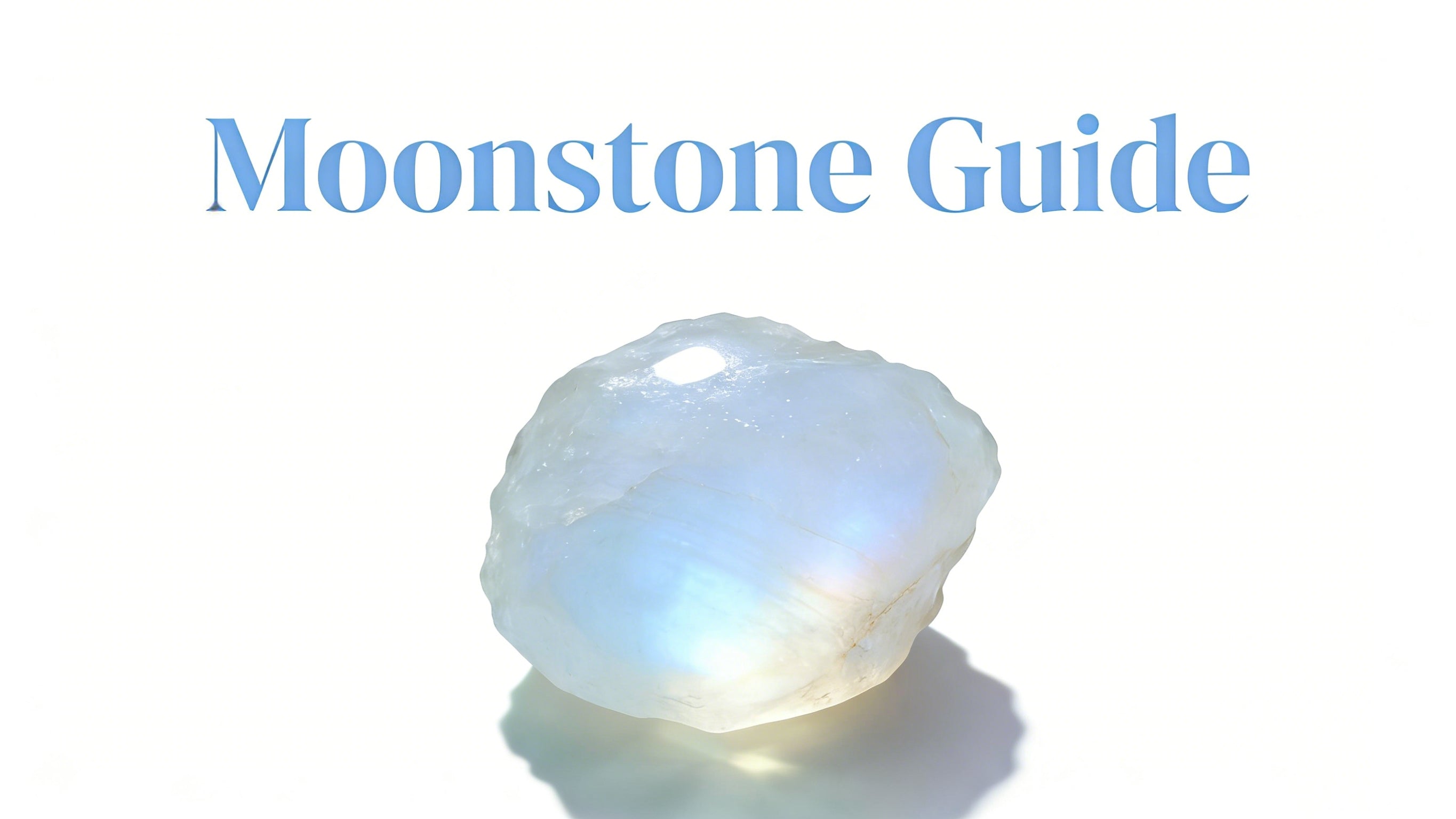
Moonstone is a member of the feldspar mineral family with a chemical composition often represented as KAlSi3O8. It forms through the intergrowth of layers of potassium feldspar and sodium feldspar. What makes moonstone valuable is a unique optical phenomenon called adularescence. When light hits the stone’s surface, it creates a soft, floating bluish-white glow within the gem—like moonlight reflected on water. This magical optical effect makes moonstone one of the most recognizable gemstones.
Moonstone Physical Properities
- Hardness and toughness: Moonstone rates 6–6.5 on the Mohs hardness scale. While not as hard as diamond or sapphire, it is suitable for everyday jewelry. However, because it has perfect cleavage in two directions, moonstone is relatively brittle and should be protected from impacts and sudden temperature changes.
- Luster: Moonstone typically exhibits a glassy to pearly luster.
- Transparency: Ranges from translucent to opaque. The highest-quality moonstones have good transparency so the moonlight effect can be displayed more fully.
- Specific gravity: Approximately 2.56–2.59, a value that can help gemologists distinguish moonstone from similar stones during identification.
- Refractive index: Ranges from about 1.518 to 1.526—another important parameter for gem identification.
- Crystal system: Monoclinic
- Fracture: Uneven to conchoidal
What is “Adularescence”?
The most enchanting feature of moonstone is undoubtedly its moonlight effect. This phenomenon is different from the dispersion of diamonds or the play-of-color in opal. Adularescence is caused by light scattering and interference within the microscopic layered structure of orthoclase and albite (sodium and potassium feldspars). When light enters the stone and reflects between these tiny layers, it produces a blue or white glow that seems to float from within the gem, creating a mysterious, dreamlike effect. This soft radiance is typically white or blue, giving moonstone an ethereal, liquid-like quality.
High-quality moonstone should display a clear, concentrated blue sheen that appears to move inside the stone as you turn it, creating a dynamic visual effect. Some moonstones may also show cat’s-eye or star effects—additional optical wonders.
How is Moonstone Formed?
The formation of moonstone crystal is a geological wonder on a microscopic scale. Moonstone is actually composed of two feldspar minerals: orthoclase (potassium feldspar) and albite (sodium feldspar). They primarily form in pegmatites or hydrothermal veins.
High-temperature mixing: Early in the magma’s formation, when temperatures are extremely high, these two minerals are completely intermixed.
Cooling: As magma rich in potassium, sodium, aluminum, and silicon cools slowly, feldspar crystals begin to form. The magma must cool at an extremely slow rate to produce large crystals and an ordered, layered structure of orthoclase and albite. The cooling process can take thousands of years or longer.
Exsolution: When temperatures reach an appropriate range (roughly 700–900 °C), potassium feldspar and sodium feldspar begin to separate into distinct layers—a process geologists call “exsolution”—creating very thin, alternating microscopic layering.
Light scattering: It is this alternating layered structure that produces the characteristic moonlight effect. When light enters the thin layers, the light waves scatter and interfere.
- If the layers are extremely thin, the scattered light produces a beautiful blue sheen.
- If the layers are thicker, the scattered light appears white.
This explains why high-quality blue moonstone crystal is so rare: it requires just the right combination of temperature, pressure, cooling rate, and magma chemistry to ensure the internal layering is extremely fine and uniform. If cooling is too rapid, the layered structure cannot fully develop; if temperature or pressure conditions are wrong, ordinary feldspar rather than moonstone may form.
What Colors is Moonstones?
Although many people think of moonstone as milky white with a blue sheen, the moonstone family actually displays a wide range of colors.
1. Classic Blue Moonstone
This is the most popular and valuable type of moonstone. High-quality blue moonstone shows a translucent, colorless or nearly colorless body with an enchanting blue glow when light hits it. This blue can range from pale sky blue to deep sea blue; the finest specimens display a strong, vivid blue adularescence. The best blue moonstones come from Sri Lanka, and overmining has made them very rare.
2. Rainbow Moonstone
Mineralogically, rainbow moonstone is actually transparent labradorite, a type of plagioclase feldspar, primarily from India. Because it also produces a stunning iridescent effect—showing blue, pink, yellow, or even green flashes—it is widely marketed as moonstone. Its sheen is typically stronger and more colorful than traditional moonstone, making it a favorite among collectors and jewelry designers.
3. White Moonstone
White moonstone displays a soft white or silvery sheen without an obvious blue tone. This stone resembles a full moon, offering a pure, simple beauty and is generally more affordable.
4. Peach and Orange Moonstone
These warm-toned moonstones mainly come from India and Madagascar. Their body color ranges from light peach to deep orange; some show a golden sheen. These moonstones typically have a weaker sheen but their warm colors feel soothing and are often used in designs emphasizing emotional healing.
5. Gray and Black Moonstone
Gray and black moonstones have become very popular recently, especially for men’s jewelry or bohemian-style pieces. Black moonstone is particularly rare; its body color ranges from silvery gray to black yet can still display the moonlight effect, usually with silver or white adularescence. The dark background creates strong contrast with the white sheen, producing a distinctive visual effect often believed to carry stronger protective (new-moon) energy.
6. Green Moonstone
Green moonstone is relatively uncommon and mainly comes from India. They range from pale to deep green and, combined with white or blue adularescence, present a fresh, natural beauty.
7. Cat’s-eye and Star Moonstone
Cat’s-eye and star moonstones are rare varieties with special optical effects. In very rare cases, if moonstone contains parallel needle-like inclusions and is cut en cabochon, it can display a “cat’s-eye” effect—a single band of light—resulting in cat’s-eye moonstone. Star moonstone shows a cross-shaped or multi-rayed star effect when multiple sets of parallel inclusions intersect.
What is the Moonstone Meaning?
Moonstone is more than just a mineral; it is one of nature’s rare gems capable of touching the human soul through shifting light.
Moonstone Symbolic Meanings
Long revered as a stone of intuition and emotional harmony, moonstone symbolizes love, balance, and fresh beginnings.
1. Feminine Energy
Moonstone is the crystal that most strongly represents the Divine Feminine on Earth. Its deep connection with the moon goddess makes it a symbol of intuition, sensitivity, motherhood, and gentleness. In ancient lore, moonstone was thought to be the solidified essence of moonlight, carrying an ocean-like capacity for acceptance. In a modern world that often prizes reason, action, and Yang (masculine) energy, moonstone can act as a soothing remedy, helping the wearer reclaim neglected emotional needs, soften overly rigid Yang energy, and bring about a harmonious balance of inner Yin and Yang.
2. Balance and Harmony
Moonstone symbolizes a “dynamic balance”. Its watery blue shimmer is believed to calm emotional turbulence. In a fast-paced, high-pressure digital age, moonstone serves as a refuge for the soul, encouraging inward exploration and helping the wearer find a personal sense of peace and harmony amid the noise.
3. New Beginnings and Transformation
Called the “Stone of New Beginnings”, moonstone symbolizes the courage to let go of the old self and embrace the unknown. Like the moon’s waxing and waning cycle—from new moon to full moon—it suggests that light follows darkness. Moonstone is especially suited to those at life’s crossroads—whether entering a new intimate relationship, crossing a career divide, marrying, or becoming a parent. It grants a “go-with-the-flow” wisdom, teaching how to remain graceful through life’s ups and downs and not fear endings, because every close signals the start of something grander.
4. Love and Romance
In the gem world, moonstone is a talisman for love, often called the “Lovers’ Stone”. It is believed to attract true love, deepen bonds between partners, and protect relationships from negative energies.
A touching folk tale says that if lovers gift each other moonstones on a full-moon night, their hearts will remain in resonance forever; their love will not only be shielded from outside negativity but will grow stronger over time. It not only attracts true love but also safeguards long-standing promises.
In Indian culture, moonstone is regarded as a highly sacred traditional wedding gift, believed to harmonize partners’ temperaments and help marriages become as complete as a full moon.
5. Traveler’s Talisman
Ancient sailors believed moonstone could protect those journeying by night. Today, it is still viewed as a guardian stone for night travelers.
Moonstone Birthstone Meanings
1. June Birthstone
As one of June’s birthstones, alongside pearl and alexandrite, moonstone symbolizes health and longevity. June marks the beginning of midsummer, full of vitality and abundance. For those born in this month, wearing moonstone birthstone jewelry is thought to help regulate bodily functions, sustain vigor, and grant a peaceful mindset, thereby deepening and extending life.
👉 Click to learn more about What is June Birthstone?
2. Zodiac Birthstone
Moonstone is the birthstone for Cancer and has a naturally close relationship with that sign. Ruled by the moon, Cancer’s emotional fluctuations align well with moonstone’s frequencies, helping Cancerians manage their sensitivity. Additionally, moonstone is an excellent supportive stone for Scorpios seeking deep emotional connection and Pisces yearning for spiritual freedom.
👉 Click to learn more about The Ultimate Guide to Zodiac Birthstones
3. 13th Anniversary Gemstone
In traditional wedding anniversary symbolism, the 13th anniversary is associated with moonstone. Although “13” is considered challenging in some cultures, gifting moonstone conveys the meaning of “softness conquering hardness”. It symbolizes that even after more than a decade of shared storms, a couple’s love can still shine fresh, enchanting, and mysterious from different angles—signifying marriage’s entry into a purer, more transparent, and spiritually aligned phase.
Moonstone Spiritual Meanings
Moonstone is not just a beautiful gem; on a spiritual level, it is endowed with deep significance and powerful energetic qualities that profoundly influence the wearer’s inner world.
1. Connection to Moon Energy
Moonstone is believed to be the material embodiment of lunar energy on Earth. It is closely tied to the moon’s cycles and is thought to absorb, store, and transmit lunar energy. Many spiritual practitioners place moonstone under moonlight to “charge” it during the full moon to enhance its energy.
2. Intuition and Insight
Spiritually, moonstone symbolizes insight and transcendent wisdom. It is believed to resonate with the Third Eye Chakra. By wearing moonstone, people may strengthen precognitive ability and psychic sensitivity. This gem does not solve problems through logic, but by enhancing the wearer’s subconscious connection so you can hear your truest inner voice during times of confusion and make wise decisions that go beyond surface appearances.
3. Chakra Associations
Moonstone primarily works on two key chakras—the Crown and the Third Eye—and can, in certain cases, activate a third chakra—the Solar Plexus.
- Crown Chakra: Located at the top of the head, it represents spiritual connection. White or clear moonstone can open the Crown Chakra, helping us feel connected to the universe and alleviating feelings of isolation.
- Third Eye Chakra: Located between the brows, it represents intuition. Moonstone with blue adularescence can strongly activate this chakra, enhancing intuition, insight, and psychic ability, helping us see a clear path when we feel lost.
- Solar Plexus Chakra: Peach or yellow moonstone works on this center, helping to dispel feelings of helplessness and gently boosting confidence, teaching one to establish personal boundaries with softness.
4. Dreams and the Subconscious
Moonstone is considered the “Stone of Dreams”, able to connect with the subconscious and reflect the truths deep within your soul, bringing deep self-understanding. Many spiritual practitioners wear moonstone while sleeping because it is believed to open the door to the subconscious, not only reducing nightmares but also increasing dream clarity and even helping people find answers to real-life problems within their dreams.
5. Spiritual Growth and Transformation
Moonstone is seen as a companion on the spiritual journey, supporting personal spiritual growth and transformation. It is believed to help people release old patterns, embrace change, and move forward on their spiritual path.
What is Moonstone Good for?
(Disclaimer: The following content is based on metaphysical and crystal-healing traditions and is not a substitute for professional medical advice, diagnosis, or treatment.)
Moonstone is thought to offer a wide range of benefits, from emotional well-being to physical healing, and from relationships to spiritual growth.
1. Mental and Emotional Healing Porperity
In crystal healing, moonstone is the go-to gem for emotional instability, often called the “Emotional Stabilizer”.
Soothing emotional overload: When you feel overwhelmed, anxious, or on the verge of an emotional breakdown, moonstone’s energy can help calm an overactive sympathetic nervous system. It does not numb you; rather it helps you observe your emotions from a detached vantage point, preventing you from being swept away by anger or sorrow.
Healing emotional wounds: For those who have deep emotional wounds (such as childhood shadows or heartbreak), moonstone’s milky glow symbolizes unconditional acceptance. It can gently bring suppressed traumas from the subconscious to the surface and help you release them—a process often described as “emotional detox.”
2. Physical Healing Properties
Because the moon’s gravitational influence on Earth’s water (tides) and biological rhythms is scientifically recognized, and the human body is about 70% water, crystal healers believe moonstone can profoundly affect the body’s fluid circulation and biological clock.
Women’s health: This is the most widely known physical effect of moonstone. It is believed to help regulate the pituitary gland and thus balance hormone secretion. Many women wear it to ease premenstrual syndrome (PMS), menstrual cramps, or to seek energetic support during pregnancy, childbirth, and breastfeeding. It is seen as a booster for fertility.
Digestion and detoxification: Emotional stress often first manifests in the gut (such as nervous stomach pain). By soothing emotional tension, moonstone indirectly supports digestive health, helping the body absorb nutrients and eliminate toxins.
Regulating sleep and the biological clock: Moonstone corresponds to the pineal gland, the center responsible for melatonin secretion and circadian rhythm regulation. For people with insomnia, vivid dreaming, or jet lag, placing moonstone under the pillow is believed to help reset the biological clock and promote deep sleep.
3. Relationship Benefits
Attracting love: Moonstone is called the “stone of love” and is believed to attract true love and soulmates.
Deepening affection: For those already in relationships, moonstone is thought to deepen emotional bonds and increase empathy and understanding.
Improving communication: Moonstone is believed to encourage open, honest communication and help resolve conflicts in relationships.
Family harmony: It is thought to create a harmonious family atmosphere and promote understanding and support among family members.
How to Use Moonstone for Healing?
To maximize moonstone’s benefits, you can try the following simple rituals:
- Full Moon Charging: On a full moon night, place your moonstone on a windowsill or outdoors so it can bathe in moonlight all night. This is considered the best way to cleanse the stone of negative energy and “charge” it.
- Wear on the Left Hand: According to energy flow principles—left in, right out, if you want to absorb moonstone’s healing energy, boost intuition, or balance hormones, be sure to wear bracelets or rings on your left hand.
- Moon Water: Place a cleansed moonstone in a glass (or beside a glass), fill with purified water, and leave it under the moonlight overnight. Drinking this “moon water” the next morning is believed to purify the body from the inside out.
The History of Moonstone
Moonstone has a long and enchanting history and has been an important gemstone in human cultures for thousands of years.
Ancient Rome: Romans believed moonstone formed from solidified moonlight and thought the gem contained the image of the moon goddess Diana. In Roman culture, moonstone was regarded as a sacred gem and was often used in religious rituals and amulets.
Ancient India: In Indian tradition, moonstone is called "Chandrakant" (moon gem) and is considered one of the most sacred stones. Indians believed moonstone crystallized from moonlight and possessed the power to foresee the future. Moonstones were often placed in the mouth to aid prophecy and were used as wedding gifts symbolizing eternal love.
Ancient Greece: The Greeks called moonstone “Aphroselene,” combining the names of the goddess of love (Aphrodite) and the moon goddess (Selene), believing the gem could bring love and wealth. They thought wearing moonstone during the full moon would enhance its power.
Middle Ages: In medieval Europe, moonstone was believed to have the ability to treat epilepsy and help people sleep. Travelers often carried moonstone as a talisman, believing it would protect them during nighttime journeys.
Renaissance: Alchemists in the Renaissance considered moonstone an important material, believing it could capture the essence of the moon for use in various mystical rituals and experiments.
Art Nouveau Period: Moonstone reached the height of its popularity during the Art Nouveau movement in the late 19th and early 20th centuries. Renowned French jewelers René Lalique and Louis Comfort Tiffany were especially fond of moonstone, making it central to their naturalistic jewelry designs to depict insects, flowing water, and mysterious creatures. The period’s admiration for moonstone made it a fashion gem among high society.
Modern Revival: From the 1960s to the 1970s, with the rise of the hippie movement and the New Age movement, moonstone regained popularity for its ethereal appearance and spiritual meaning, becoming a symbol of Bohemian style. It was seen as a tool for connecting with the spiritual world and symbolized peace, love, and harmony.
Where Is Moonstone Found?
Moonstone is found in many regions around the world, and moonstones from different locales have distinct characteristics and qualities.
Sri Lanka: Sri Lanka is one of the world’s most important sources of moonstone and has been mined for centuries. Sri Lankan moonstone is famous for its high-quality blue sheen, usually offering good transparency and a strong adularescence. The Meetiyagoda area is the country’s most famous moonstone mining region; however, older mines are nearly depleted, driving up prices for this high-quality material.
India: India is another significant source of moonstone, especially in the states of Rajasthan and Odisha. Indian moonstones are known for their rainbow effects and warm tones, often displaying flashes of multiple colors. India also produces peach and orange moonstones.
Myanmar: Myanmar produces high-quality glassy moonstone characterized by a strong blue sheen and very high clarity, though production is limited.
Madagascar: Madagascar is a relatively new moonstone source and has become an important supplier since the 1990s. The region yields larger moonstones in a range of colors, including blue-white, peach, and rainbow varieties.
Tanzania: In recent years, Tanzania has also become an important source of moonstone, producing high-quality blue moonstones.
Other sources: Moonstone is also found in the United States (Virginia, North Carolina, New Mexico), Brazil, Australia, Norway, and Switzerland, though these locations typically produce smaller quantities.
How Much is Moonstone Worth?
Unlike diamonds, which have strict international grading standards, moonstone valuation relies more on visual appeal and rarity. We can still apply the diamond 4Cs (color, clarity, cut, carat weight) to assess moonstone value, but the emphasis differs greatly.
1. Color and Luster
This is the most critical factor determining a moonstone’s value; its weight often exceeds that of all other factors combined. Evaluating a moonstone’s color actually involves two parts: body color and sheen/adularescence.
Body color: The ideal moonstone body color is nearly colorless and transparent, like clear water. The cleaner the background, the more vivid the emerging glow.
Sheen (Adularescence): A high-quality moonstone should display a strong, concentrated blue sheen that doesn’t sit rigidly on the surface but flows within the stone as it turns, like living water. The stronger and purer the light effect, the higher the value.
- Electric Blue: This is the crown of moonstones. This blue is deep, vivid, and bright—like a neon light turned on. A colorless, glassy moonstone that shows strong electric blue is a collector’s treasure.
- Silvery White and Rainbow Sheen: Silvery-white adularescence is most common and more affordable. Rainbow sheen (technically labradorescence from labradorite) is also popular for its multicolored effects, but strictly speaking in terms of mineral rarity, pure Sri Lankan blue moonstone is more valuable.
Orientation of the sheen: In a top-quality moonstone, the blue should be centered. If the glow is off to one side or only visible from extreme angles, the value drops significantly.
2. Clarity
Generally, the more transparent the moonstone, the higher its value.
Moonstone transparency grades:
Glass Body: Fully transparent like glass. This is the highest grade, allowing maximum light transmission and producing a pronounced “3D depth of light”.
Creamy/Milky Body: Semi-transparent, like milk or thin mist. These have a soft, romantic glow but are commercially less valuable than glass body stones.
Opaque: Typically used for lower-end jewelry or bead strands.
However, moonstone is part of the feldspar family and naturally tends to develop fissures and inclusions. Tiny inclusions invisible to the naked eye are usually acceptable. But large cracks, especially those reaching the surface, not only hurt appearance but greatly reduce value. “Centipede” inclusions are typical in moonstone; under a microscope or magnifier you’ll often see fine tension cracks resembling many-legged centipedes—this is a marker of natural moonstone.
3. Cut
Moonstone cutting doesn’t aim for diamond-like fire; it aims to maximize the adularescence effect.
Cabochon: Over 90% of moonstones are cut as cabochons, which best showcase their optical properties.
- High dome: Top-quality cutting preserves a higher dome. A high dome concentrates and sharpens the blue sheen, creating excellent visual effect.
- Flat cut: If the stone is cut too flat, while it may appear larger in surface area, its luster becomes diffuse and weak, losing the moonstone’s charm.
- Faceted: Recently, faceted moonstones (e.g., rose cuts) have appeared on the market to increase fashion appeal. Faceting increases surface reflections and sparkle but often interrupts the continuity of internal adularescence. Typically, only material with high clarity but weak blue sheen is faceted, attempting to compensate for lack of adularescence with cut brilliance.
- Shape and symmetry: The most common cut is oval, followed by pear and round. When inspecting, check whether the base is flat and whether the cabochon outline is symmetrical. Crooked cutting usually indicates aesthetic compromises made to preserve weight.
4. Carat Weight
Although moonstone is common, large and high-quality specimens are extremely rare. It is relatively easy to find good blue moonstones under 5 carats. 5–10 carats is a dividing line: if a stone in this weight range retains “glass body + strong blue sheen,” its price tends to jump exponentially rather than increase linearly by carat. Moonstones over 10 carats are nearly museum- or top-collector-level and are very rare.
As crystal size increases, the likelihood of internal cracks and impurities also increases dramatically. Therefore, a large but cloudy moonstone is often worth far less than a small, exquisitely clear one. When shopping, prioritize quality (color and clarity) over sheer size.
5. Origin
Although moonstones are found in many places, origin still affects value in the high-end market.
Top tier (collector-grade): Sri Lanka produces the most authentic “royal blue” moonstone—transparent body and deep, serene blue sheen. As older mines are depleted, prices for Sri Lankan blue moonstones continue to rise.
Second tier (commercial-grade): India produces many rainbow moonstones (labradorite) and ordinary blue moonstones. While high-quality material exists, overall market prices are generally lower than Sri Lankan supplies.
Third tier (jewelry-grade): Stones from other regions, or those with cloudy body color and weak sheen, are typically used for silver jewelry or bead strands and are priced by weight or per strand rather than by carat.
6. Moonstone Price Range
The market price of moonstone varies widely, ranging from a few dollars per carat for entry-level rough stones to several hundred dollars per carat for top-tier specimens.
Commercial-grade moonstone: Prices may be about $5–$20 per carat. These stones tend to be cloudy, showing a milky or semi-translucent haze (creamy body). While they may display adularescence, it is usually white or a faint pale blue. They often have visible cracks or inclusions to the naked eye. Commercial-grade moonstones are most commonly cut into small beads or flat freeform shapes for use in bracelets, simple sterling silver studs, or fast-fashion jewelry.
Mid-range moonstone: This is the grade most often used by jewelry counters and independent designers and is commonly set in 18K gold or high-quality 925 silver. Mid-range moonstones typically cost about $20–$80 per carat, offering excellent value and visual appeal. These stones are usually semi-translucent with a clearly visible blue sheen that can be very captivating at certain angles. Although small “centipede-like” internal patterns may still be present, they do not detract from the overall luster of the gem.
High-quality moonstone: Prices can range from about $100–$300 per carat. These stones are nearly fully transparent—“glass-like”—with almost no visible flaws to the naked eye. At this price level, moonstones begin to have investment and collectible value. The hallmark of high-quality moonstone is a strong electric blue adularescence—this blue glow is vivid even in dimmer light. The shimmer is usually centered and covers most of the stone’s surface.
Top-tier moonstone: $500 per carat or more; for glassy stones over 15 carats with strong blue sheen, the per-carat price can even exceed $1,000. These moonstones are extremely transparent, with blue flashes as deep as the ocean and a pronounced three-dimensional effect. They are exceedingly rare on the market and are often found in high jewelry collections from top brands or at international auctions.
Although moonstone is not traditionally viewed like diamonds or colored gemstones for investment, high-quality moonstones do have appreciation potential—especially top-tier Sri Lankan blue moonstones, large rainbow moonstones, specimens with rare colors or optical effects, or antique moonstone jewelry from the Art Nouveau period.
How to Tell If a Moonstone is Real?
As moonstone becomes popular in the jewelry market, counterfeits have proliferated. For inexperienced buyers, the most common pitfall is mistaking opalite or man-made glass for natural moonstone. Although the name “opalite” sounds like a gemstone, it is actually industrially produced glass and lacks the spirit and value of a natural mineral. Here are several practical ways to tell real moonstone from fake:
1. Observe the “Dynamic” Quality of the Schiller (Core Method)
The adularescence of natural moonstone (orthoclase/rock crystal feldspar) is highly directional.
- Real: When you slowly rotate the stone, the light should appear to “move” or flow within the stone. The blue sheen is strongest only at certain angles.
- Fake: Counterfeits (such as man-made opalite) usually show an all-over sheen. From any angle the stone looks uniformly, dullly milky blue, lacking that deep, shimmering play of light.
2. Examine Internal Inclusions
Natural moonstone forms in complex geological conditions and almost inevitably bears growth marks.
- Real: Under magnification, natural moonstone typically shows parallel, layered structures or tiny “centipede-like” inclusions that resemble multi-legged insects. These imperfections may affect clarity but serve as an “ID” for natural origin.
- Fake: Man-made imitations often look too perfect or contain round bubbles that would never occur in natural minerals. If the interior looks like pure, featureless water and the price is low, be highly suspicious.
3. Check the Body Color
- Real: Natural moonstone body colors are usually colorless, white, gray, or a faint brown.
- Fake: Man-made opalite, when backlit, often shows an unnatural orange-yellow or pinkish tint. This is a scattering effect from additives in the glass and is a typical characteristic of synthetic glass.
4. Feel and physical properties
- Real: As a natural mineral, moonstone has good thermal conductivity; it feels cool to the touch and warms up slowly.
- Fake: Glass or plastic imitations heat up quickly in your hand and are usually lighter than natural stones, lacking the solid “weighty” feel a gemstone should have.
For high-value moonstone, the safest way to verify authenticity is to ask the seller for an authoritative third-party identification report (such as China’s CMA or GIC, or international labs like GIA or GRS). An official report not only proves whether the gem is genuine but will also indicate if it has undergone any treatments.
Moonstone in Jewelry
Moonstone’s place in the history of jewelry design is nearly irreplaceable. Its unique adularescence makes it a favored material for designers seeking spirituality, softness, and a sense of mystery.
Moonstone Rings
Moonstone rings are among the most popular styles because the wearer can glance down and admire the blue glow that shifts with hand movement. Increasingly, brides and grooms are choosing moonstone as the center stone for engagement rings. It symbolizes purity and new beginnings, offering couples who want something personal an excellent alternative to traditional diamonds. Because moonstone has cleavage, professional jewelers typically recommend bezel settings to securely surround the stone with metal—both vintage in feel and protective.
At LUO Jewelry, we understand every moonstone ring carries the wearer’s emotional memories. To balance aesthetics with durability, LUO Jewelry’s artisans have developed a “breathable bezel” technique. While ensuring the metal firmly protects the stone’s edge, precise bottom hollowing allows light to pass freely through the gem, letting the moonstone present a deep, ocean-like blue flash at the fingertip.
Necklaces and Pendants
Moonstone pendants showcase the gem’s full beauty, allowing light to enter from multiple angles and fully activate its internal sheen. Both minimalist single-stone pendants and intricate vintage moonstone necklace designs are popular. A simple single-stone pendant complements an intellectual elegance, while layering pendants of different sizes and sheens (for example, blue moonstone paired with gray moonstone) is a sophisticated modern technique for creating visual depth.
LUO Jewelry’s moonstone necklaces collection is made for those who pursue ultimate clarity. We insist on using only natural, high-quality moonstone rough. Every moonstone chosen for LUO Jewelry’s supply chain must pass strict optical testing to ensure its blue adularescence radiates evenly from the center outward, so that with every turn the wearer exudes the same elegant rhythm as moonlight gently caressing a lake.
Moonstone Earrings
Earrings are an ideal way to display moonstone. As the wearer moves or speaks, moonstones at the ear catch ambient light, lending a soft, ethereal aura to the face. Whether simple moonstone studs or graceful drop earrings, moonstone flatters facial features nicely.
Moonstone Jewelry Styles
Vintage Style: Mentioning moonstone calls to mind the late 19th-century Art Nouveau movement. Legendary jeweler René Lalique adored moonstone, believing its veiled beauty surpassed the bluntness of diamonds. In vintage designs, moonstone is often combined with enamel, filigree wire, and natural motifs like insects and florals to evoke a dreamlike, forest-spirit feel.
Modern Minimalism Style: Contemporary designers emphasize moonstone’s translucency, cutting it into geometric shapes or irregular natural forms paired with brushed metals. These designs highlight the gem’s pristine purity without excessive ornamentation, ideal for modern women who favor a minimalist aesthetic.
Bohemian Style: In Bohemian styles, moonstone is often left with a more rustic finish or even presented as raw stone. It’s frequently layered with turquoise or labradorite and set in oxidized, antiqued silver to evoke a mysterious, free-spirited, exotic wanderer vibe.
Metal Pairings
Sterling Silver: Silver is moonstone’s oldest and most classic partner. Silver’s cool white tone perfectly complements moonstone’s blue adularescence, together creating a moonlit, refined atmosphere. Sterling silver moonstone jewelry is also the most cost-effective and broadly appealing combination on the market.
👉 Click to learn more about Your Ultimate Guide to Sterling Silver Jewelry(Part 1)
Yellow Gold: Pairing gold with moonstone produces a striking color contrast. The warm metal surrounds the cool blue glow, creating a luxurious yet gentle effect. Yellow gold moonstone jewelry works particularly well with peach or orange moonstones as center stones, bringing out the gem’s warm internal fire.
Rose Gold: Rose gold’s pinkish tone harmonizes with moonstone’s soft glow, emitting a romantic, feminine charm. Rose gold moonstone pieces have become especially popular in bridal jewelry and affordable luxury accessories, and they flatter Asian skin tones especially well.
White Gold / Platinum: For glassy, strong-blue top-quality moonstones, platinum and white gold is the best choice. Platinum’s stable physical properties provide the safest protection for the gem, and its premium feel instantly elevates the collectible value of a moonstone piece.
LUO Jewelry leads fashion trends with a range of moonstone pieces in different styles, avoiding excessive ornamentation and instead using pure metal lines so the gem’s innate spirit becomes the visual focus.
How to Care for Moonstone?
Although moonstone is beautiful and captivating, it has a Mohs hardness of only 6.0–6.5 and exhibits perfect cleavage in two directions. This means it is much more fragile than many common gemstones (such as quartz, ruby, sapphire, and diamond). Without proper care, the surface can be easily scratched, and impacts may cause it to cleave or fracture along its cleavage planes.
How to Clean Moonstone Jewelry?
The safest method is to clean moonstone jewelry with warm, soapy water. Excessive chemical exposure or vigorous physical shock can cause irreversible damage.
- Prepare a bowl of warm water (do not use boiling water; sudden temperature changes can worsen internal cracks).
- Add soap or a few drops of a mild, neutral detergent (such as dish soap or hand soap). Avoid cleaners containing bleach, ammonia, or acidic components.
- Soak the moonstone jewelry for 2–5 minutes, then gently brush dirt from the back of the stone and the setting crevices with an extremely soft toothbrush.
- Rinse thoroughly under running warm water and dry by blotting with a soft, lint-free cloth (such as an eyeglass cloth or chamois).
Note that ultrasonic cleaners are strictly prohibited, as their high-frequency vibrations can easily trigger cleavage in moonstone, causing internal cracks or even fragmentation. Steam cleaning is also not recommended, because high temperature and high-pressure steam can cause uneven heating, dull the stone’s luster, or create thermal fractures.
How Should Moonstone be Stored?
Because moonstone has moderate hardness, airborne dust (whose main component is quartz with hardness 7) or friction from other jewelry can leave fine scratches on its surface.
- Store separately: never keep moonstone together with harder gems like diamonds, rubies, sapphires, or moissanite. It’s best to use a dedicated soft pouch for your moonstone jewelry or place each piece in its own jewelry compartment lined with soft velvet.
- Avoid extreme conditions: prolonged exposure to strong direct sunlight or high heat may alter the color or cause some moonstones to dry out and crack. When not wearing your moonstone, store it in a cool, dry place.
- Protect from chemicals: moonstone is sensitive to chemicals. Follow the “last on, first off” rule: put on jewelry after applying makeup, perfume, and hairspray; remove and store moonstone before bathing, swimming, or doing household chores that involve chemical cleaners.
Conslusion
Moonstone is a truly enchanting gem. In today’s fast-paced, stressful world, the introspection, calm, and gentleness that moonstone symbolizes are especially precious. I hope this moonstone guide has helped you better understand this gem.
Whether you are drawn to its mysterious blue shimmer, seeking emotional comfort, or celebrating a June birthday, owning a high-quality moonstone piece is a lovely investment in yourself. When buying moonstone, remember to prioritize quality over size and purchase from reputable sellers, such as LUO Jewelry.
LUO Jewelry is committed to selecting high-quality natural moonstones and using traditional handcrafting techniques to preserve the stone’s original growth patterns while giving moonstone jewelry innovative styles. We offer high-quality moonstone jewelry, including rings, necklaces, and moonstone earrings, and strive to transform this gift of nature into a radiant moment for every wearer.
If you have more questions about moonstone, feel free to consult our professional gem experts at any time.