
Moissanite vs. Diamond: What Are the Differences?
When choosing a gemstone for an engagement ring, diamond is no longer the only option available to today's buyers. Moissanite and lab-grown diamonds have become increasingly popular alternatives, reshaping how people think about fine jewelry purchases. These stones are not the same, however, and each offers very different characteristics in terms of composition, appearance, durability, and price. As more consumers research their options before making such a significant purchase, understanding these distinctions has become essential rather than optional.
One question that surfaces repeatedly among shoppers researching this topic is straightforward: Is moissanite a diamond? The answer is no. Moissanite and diamond are two entirely distinct gemstones, differing in chemical composition, optical properties, and geological or laboratory origin. While both stones can appear strikingly similar to an untrained eye, particularly in photographs or under certain lighting conditions, they behave quite differently once you examine them closely or observe them under varied light sources.
This guide will walk through exactly what separates these stones, helping you make an informed decision for your next jewelry purchase.
What Is Moissanite?
Moissanite is a gemstone known for its exceptional brilliance and affordability. It has earned a reputation as one of the most convincing and popular diamond alternatives currently available in the jewelry market. Its combination of affordability and exceptional sparkle has attracted a growing number of buyers, particularly those shopping for engagement rings on a defined budget.
Understanding what moissanite actually is and how it differs fundamentally from diamond requires looking at both its history and its scientific composition.
The Origin of Moissanite
Natural moissanite is remarkably rare, so rare in fact that it has never been found in large enough quantities to support commercial mining operations. The gemstone's story begins in 1893, when French chemist Henri Moissan was examining rock samples collected from a meteorite crater located in Arizona. While analyzing these samples under a microscope, Moissan discovered small, shimmering crystals that he initially believed were diamonds, given their brilliance and hardness.
Further scientific analysis, however, revealed that these crystals were not diamond at all. Instead, they were composed of silicon carbide, a mineral compound that had not previously been documented as occurring naturally on Earth. This discovery was significant enough that the gemstone was later named moissanite in honor of Henri Moissan's contribution to its identification. Years later, Moissan would go on to win the Nobel Prize in Chemistry, though his work on isolating fluorine, rather than his moissanite discovery, was the primary reason for that recognition.
Because natural moissanite is found almost exclusively in meteorite fragments and certain rare geological formations, it exists in quantities far too small to meet commercial jewelry demand. This extreme rarity meant that for decades, moissanite remained largely a scientific curiosity rather than a viable option for jewelry production. It was not until the 1990s that scientists successfully developed methods to create moissanite in laboratory settings, replicating its crystal structure with remarkable precision and consistency.
Today, virtually all moissanite used in jewelry is lab-created rather than mined. This laboratory process allows manufacturers to produce stones with consistent quality, size, and clarity, making moissanite widely accessible to consumers in a way that natural moissanite never could be. The lab-created stones are chemically identical to their natural counterparts, meaning buyers are getting genuine moissanite, simply produced through controlled scientific processes rather than extracted from rare meteorite deposits.
What Is Moissanite Made Of?
Moissanite is composed of silicon carbide, commonly abbreviated as SiC in scientific literature. This chemical composition represents a fundamental departure from diamond, which consists purely of carbon atoms. The distinction in chemical makeup is not merely academic; it directly influences how each stone interacts with light, how hard each stone is, and how each stone performs over years of daily wear.
The crystal structure of moissanite is hexagonal, meaning its atoms arrange themselves in a six-sided lattice pattern. Diamond, in contrast, forms in a cubic crystal lattice, with carbon atoms bonding in a different geometric arrangement entirely. This structural difference between hexagonal and cubic lattices affects the way each material transmits, bends, and disperses light as it passes through the stone.
From an optical properties standpoint, silicon carbide has a notably higher refractive index than diamond. The refractive index measures how much a material bends light as it enters and exits the stone, and a higher refractive index generally translates to more dramatic light bending and, consequently, more visible sparkle. This scientific property is a primary reason why moissanite often appears even more brilliant than diamond under certain lighting conditions, a characteristic that surprises many shoppers who assume diamond automatically outperforms every alternative stone.
How Does Moissanite Look?
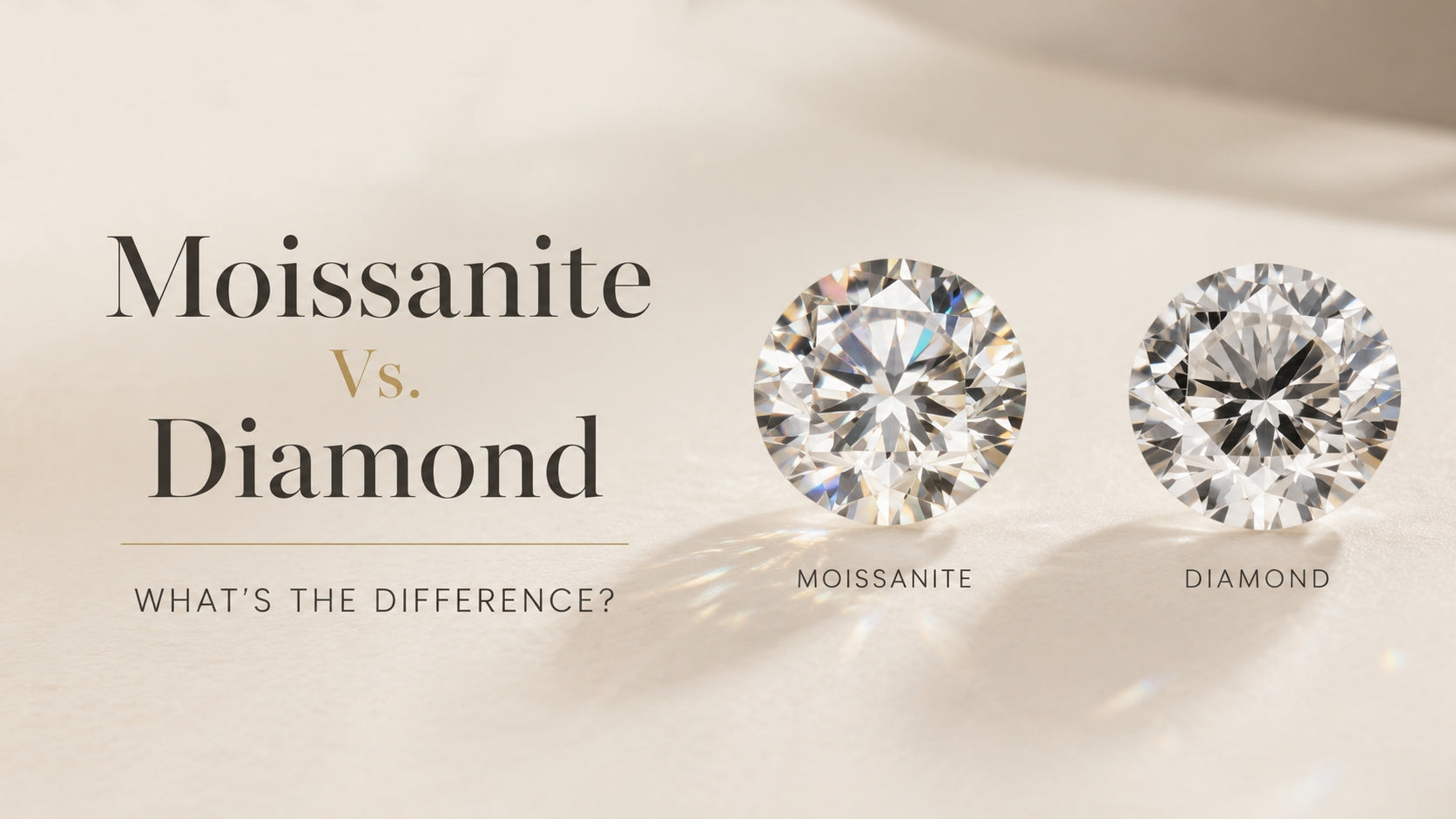
Moissanite is widely celebrated for its high brilliance, a quality that often exceeds what diamond exhibits under comparable lighting. When light enters a well-cut moissanite stone, it bounces and refracts in ways that produce an intense, eye-catching sparkle that many buyers find genuinely mesmerizing. This brilliance is part of what has fueled moissanite's growing popularity among shoppers who prioritize maximum visual impact.
Beyond brilliance, moissanite exhibits strong fire, a term used in gemology to describe the flashes of spectral color that appear when white light disperses into its component colors as it exits a gemstone. Moissanite's fire tends to be more pronounced and more colorful than diamond's fire, producing noticeable rainbow flashes that catch the eye from various angles.
These rainbow flashes represent one of moissanite's most distinctive characteristics, and reactions to this effect tend to vary among buyers. Some people are drawn specifically to this vivid, colorful sparkle, viewing it as a unique and desirable feature that sets their jewelry apart from more traditional diamond pieces. Others, particularly those seeking a stone that closely mimics the classic white brilliance of diamond, may find the rainbow effect slightly more noticeable than they prefer, especially in larger stones or under direct sunlight.
Overall, moissanite possesses a genuinely distinctive optical appearance. While it shares surface-level similarities with diamond, particularly in terms of clarity and colorlessness in high-quality stones, its fire and brilliance create a visual signature that experienced jewelers and gemologists can often identify without specialized equipment, simply by observing how the stone throws light.
What Is Diamond?
Diamond holds a position in the jewelry world that few other gemstones can match, having served as the traditional centerpiece of engagement rings for well over a century. Its combination of rarity, hardness, and deep cultural symbolism has cemented its status as the classic choice for symbolizing commitment and lasting love.
What Is Diamond Made Of?
Diamond is composed entirely of carbon atoms, arranged in a highly organized crystalline structure that gives the stone its exceptional properties. This carbon-based composition might seem simple on the surface, given that carbon is one of the most abundant elements on Earth, but the specific conditions required to transform carbon into diamond are anything but ordinary.
The crystalline structure of diamond forms when carbon atoms bond together in a cubic lattice pattern under precise conditions of extreme pressure and extreme temperature. This particular atomic arrangement is what grants diamond its remarkable hardness, transparency, and ability to disperse light so effectively. Natural formation of this structure occurs deep within the Earth, a process that takes an extraordinarily long time and requires conditions that exist only in specific geological environments.
The physical properties that result from this carbon crystalline structure include diamond's status as the hardest known natural material, its high thermal conductivity, and its exceptional optical clarity when properly cut and polished. These properties collectively explain why diamond has remained so highly valued across cultures and throughout history, both as a symbol of commitment and as a testament to the remarkable geological processes occurring beneath our feet.
How Are Natural Diamonds Formed?
Natural diamonds form deep within Earth's mantle, typically at depths ranging from 90 to 150 miles below the planet's surface. At these extreme depths, carbon deposits are subjected to conditions that simply cannot be replicated anywhere near the Earth's surface under natural circumstances. The extreme pressure and temperature found at these depths, often exceeding 2,000 degrees Fahrenheit combined with pressure hundreds of thousands of times greater than atmospheric pressure at sea level, force carbon atoms into the dense, organized structure that defines diamond.
This formation process does not happen quickly. The geological processes responsible for creating natural diamonds typically span one to three billion years, meaning that many of the diamonds sold in jewelry stores today began forming before complex life even existed on Earth. This staggering timeframe is part of what gives natural diamonds their profound sense of rarity and historical significance.
Once formed, these diamonds remain deep within the Earth until volcanic activity brings them closer to the surface. This transportation occurs through violent volcanic eruptions that carry diamonds upward through narrow, pipe-like geological formations composed of a rock called kimberlite. These kimberlite pipes serve as the primary source that mining companies target when searching for natural diamond deposits, since diamonds rarely occur anywhere else in significant, accessible quantities.
This entire natural journey, from deep formation over billions of years to violent transport toward the surface, is part of what many buyers find so meaningful about natural diamonds. Each stone represents an almost unimaginable span of geological history, condensed into a small, brilliant object that can be worn on a finger.
What Makes Diamond Different?
Diamond distinguishes itself through several defining characteristics, starting with its exceptional hardness. Ranking a perfect 10 on the Mohs hardness scale, diamond stands as the hardest naturally occurring material known to science. This hardness translates directly into practical benefits for jewelry wearers, since diamond resists scratching far better than nearly any other material it might encounter during daily wear.
Beyond hardness, diamond offers high brilliance and strong light performance, qualities that result from its unique combination of refractive index and dispersion properties. When cut correctly, a diamond captures light entering from various angles and returns it to the viewer's eye in a display of white brilliance combined with more subtle flashes of color, creating the classic sparkle that has captivated people for generations.
Diamond also carries long-established cultural significance that extends far beyond its physical properties. For over a century, diamonds have been closely associated with engagement and marriage, largely due to sustained marketing efforts throughout the twentieth century combined with the stone's genuine rarity and beauty. This cultural weight means that for many buyers, choosing a diamond carries symbolic importance that goes beyond simple aesthetic preference.
Finally, diamond's natural rarity continues to play a significant role in its enduring value and desirability. Despite advances in mining technology, natural diamonds remain genuinely scarce relative to global demand, a scarcity that supports their position as a premium gemstone choice across cultures and markets worldwide.
What Is a Lab Diamond?
Lab diamonds, sometimes referred to as lab-grown or lab-created diamonds, have experienced remarkable growth in popularity over the past decade. These stones provide buyers with a genuine diamond option that often comes with a reduced price tag and addresses certain environmental or ethical concerns that some consumers associate with traditional diamond mining operations.
How Are Lab Diamonds Made?
Lab diamonds are produced using one of two established methods, each capable of creating genuine diamond crystals through carefully controlled scientific processes.
The first method, known as HPHT, which stands for High Pressure High Temperature, works by essentially replicating the natural diamond formation process within a laboratory setting. This method subjects a small carbon source to extreme pressure and extreme heat, conditions similar to what occurs naturally within Earth's mantle, causing the carbon to crystallize into diamond form over a period of days or weeks rather than billions of years.
The second method, called CVD, short for Chemical Vapor Deposition, takes a different scientific approach entirely. This process begins with a small diamond seed placed inside a specialized chamber filled with carbon-rich gas. The chamber is then heated to extremely high temperatures, causing the gas to break down and release individual carbon atoms. These carbon atoms gradually deposit onto the diamond seed, building up layer by layer until a complete diamond crystal has formed.
Both of these methods, despite their different technical approaches, produce a final result that is chemically and structurally identical to natural diamond. The carbon atoms bond in the same cubic crystal lattice, creating a stone with the same hardness, optical properties, and overall composition as a diamond formed naturally over billions of years within the Earth.
Is a Lab Diamond a Real Diamond?
Yes, a lab diamond qualifies as a genuinely real diamond in every meaningful sense. It shares the same carbon-based composition, the same crystal structure, and the same optical and physical properties that define natural diamond. This is not a matter of opinion or marketing language; it reflects established scientific and regulatory consensus on the matter.
The Federal Trade Commission, along with major gemological institutions including the Gemological Institute of America, formally recognizes lab-grown diamonds as authentic diamonds.
Lab Diamond vs. Natural Diamond
Given that lab diamonds and natural diamonds share identical chemical compositions and physical properties, they are visually indistinguishable to the naked eye. Even experienced jewelers typically cannot differentiate between the two without specialized equipment, since standard visual inspection reveals no meaningful differences in how the stones look, sparkle, or perform under light.
The only substantive difference between lab diamonds and natural diamonds lies in their origin story: one forms naturally over the course of billions of years deep within the Earth, while the other is created through a controlled scientific process within a laboratory over a matter of days or weeks. The end product, in terms of physical composition, remains fundamentally the same.
Distinguishing between lab and natural diamonds generally requires sophisticated equipment available only through professional gemological laboratories. These labs use specialized tools designed to detect subtle trace elements or growth patterns that can indicate whether a stone formed naturally or was created in a laboratory setting.
The primary differences that matter to most buyers ultimately come down to origin, price, and personal values rather than visual or physical distinctions. Lab diamonds are generally priced significantly lower than natural diamonds of comparable size and quality, often representing savings of 30 to 50 percent or more compared to their natural counterparts. Natural diamonds, meanwhile, continue to carry appeal rooted in their geological rarity and the almost unimaginable formation process spanning billions of years, characteristics that some buyers feel add both sentimental and long-term monetary value to their purchase.
Moissanite vs. Diamond: Key Differences
Understanding the core differences between moissanite and diamond can provide meaningful clarity when deciding which stone best aligns with your specific priorities and preferences.
| Feature | Moissanite | Diamond | Lab Diamond |
| Chemical Composition | Silicon carbide |
Carbon |
Carbon |
| Origin | Primarily lab-created | Naturally formed | Lab-grown |
| Hardness | ~9.25 Mohs | 10 Mohs | 10 Mohs |
| Brilliance | Very high | Very high | Very high |
| Dispersion / Fire | Higher | Lower than moissanite | Similar to natural diamond |
| Appearance | Distinctive rainbow flashes | Classic diamond appearance | Essentially diamond appearance |
| Price | Generally lower | Generally higher | Generally lower than comparable natural diamonds |
| Identity | Different gemstone | Diamond | Diamond |
1. Chemical Composition
Moissanite is composed of silicon carbide, a compound entirely different from the pure carbon that makes up diamond, whether that diamond formed naturally or was created in a laboratory. This fundamental difference in chemical composition influences virtually every other characteristic that distinguishes these two stones, from their relative hardness to their distinct optical performance under various lighting conditions.
2. Origin
Natural moissanite exists in such extreme rarity that it holds little practical relevance to the commercial jewelry market, meaning nearly all moissanite sold today has been created in laboratory settings using advanced scientific processes. Natural diamonds, by contrast, form deep within the Earth over the course of one to three billion years, while lab diamonds are grown through controlled laboratory methods that replicate natural diamond formation in a dramatically compressed timeframe.
3. Hardness and Durability
Diamond ranks a perfect 10 on the Mohs hardness scale, officially making it the hardest known natural material on Earth. Moissanite ranks slightly below diamond at 9.25 on this same scale, a rating that still places it among the hardest gemstones available for jewelry use. In practical terms, both stones resist scratching extremely well and hold up admirably to daily wear, though diamond maintains a slight technical advantage in overall hardness that becomes relevant primarily in extreme, long-term wear scenarios.
4. Brilliance and Fire
Moissanite typically displays noticeably more fire than diamond, a direct result of its higher refractive index, which causes more dramatic light dispersion as light passes through the stone. This increased fire produces more visible flashes of rainbow color, particularly under direct sunlight or bright indoor lighting.
Diamond, in comparison, offers a more balanced form of brilliance, characterized by a whiter, more subtle sparkle that many people specifically associate with the traditional diamond aesthetic. This distinction in light performance represents one of the most noticeable practical differences between the two stones when viewed side by side.
5. Color and Appearance
High-quality moissanite generally presents as colorless or near-colorless, though certain stones can exhibit a slight gray or yellow tint depending on lighting conditions and stone quality. Diamonds, meanwhile, are graded according to a standardized color scale ranging from D, representing completely colorless stones, to Z, representing stones with a noticeably light yellow or brown tint. This standardized grading system gives diamond buyers precise control over the exact color grade they select, a level of specificity that moissanite grading does not offer in quite the same structured way.
6. Price and Value
Why Is Moissanite Less Expensive?
Moissanite costs considerably less than diamond, primarily because it does not carry the same natural rarity that drives diamond pricing, and its laboratory creation process requires fewer resources and less time than either natural diamond mining or lab diamond growing. A moissanite stone can cost roughly one-tenth the price of a diamond of comparable size and visual quality, making it an especially attractive option for buyers who want to maximize carat weight and visual impact without stretching their budget.
Are Diamonds More Valuable Than Moissanite?
When it comes to resale value and sustained market demand, diamonds generally hold their value more effectively than moissanite over time. This advantage stems largely from diamond's well-established grading systems, deep cultural significance, and genuine natural rarity, all factors that contribute to consistent demand across both primary retail markets and secondary resale markets. Moissanite, while an excellent value at the point of purchase, does not typically retain comparable resale value in the secondary jewelry market.
Moissanite vs. Lab Diamond: What Is the Difference?
While moissanite and lab diamonds both serve as popular alternatives to natural diamonds, they represent fundamentally different gemstones with distinct chemical compositions and optical characteristics.
Moissanite vs. Lab Diamond at a Glance
| Moissanite | Lab Diamond | |
| Is it a diamond? | No | Yes |
| Composition | Silicon carbide | Carbon |
| Origin | Primarily lab-created | Lab-created |
| Hardness | ~9.25 | 10 |
| Optical character | Strong fire and brilliance | Diamond-like brilliance and fire |
| Price | Generally lower | Generally higher than moissanite |
| Best for | Distinctive sparkle and value | Traditional diamond appearance |
Which Looks More Like a Diamond?
Lab diamonds inherently look more like natural diamonds, simply because they are chemically and structurally identical to natural diamonds in every meaningful way. Their faceting patterns, light reflection properties, fire, and overall visual character match natural diamonds precisely, a direct consequence of sharing the exact same material composition.
Moissanite, while undeniably beautiful in its own right, carries a distinctive optical signature that sets it apart from diamond. Its fire tends to be more pronounced, frequently producing more colorful and more frequent flashes than a diamond would display under identical lighting conditions. For buyers specifically seeking a stone that closely replicates the traditional diamond look in every visual respect, lab diamonds provide a considerably closer match. For those who appreciate a livelier, more colorful, and more attention-grabbing sparkle, moissanite offers its own compelling and distinctive appeal that some buyers actively prefer over diamond's more restrained brilliance.
Which Is More Affordable?
Moissanite remains considerably more affordable than lab diamonds when comparing stones of similar size and visual quality. While lab diamonds already cost significantly less than natural diamonds, they still carry a meaningfully higher price than moissanite, largely due to the more complex, resource-intensive, and time-consuming process required to grow a genuine diamond crystal structure compared to producing silicon carbide crystals in a lab setting.
Moissanite vs. Diamond: Which Is Right for You?
Choosing between moissanite and diamond ultimately depends on your specific priorities regarding appearance, budget, durability expectations, and what the stone personally represents to you and your relationship. At LUO Jewelry, we understand that this decision is deeply personal, which is why we offer a thoughtfully curated selection of both Moissanite Jewelry and Diamond Rings, allowing you to explore high-quality options across both categories and find the piece that genuinely feels right for your unique story and circumstances.
1. Choose Moissanite If You Want...
Moissanite represents an excellent choice for buyers who are drawn to a distinctive, attention-grabbing sparkle paired with strong rainbow fire that catches the eye from across a room. It offers excellent durability suitable for daily wear, standing up well to the demands of everyday life without excessive concern about scratching or damage. Moissanite also provides a lower-cost option that grants buyers considerably more flexibility with their overall jewelry budget, whether that means selecting a larger center stone or allocating more funds toward an elaborate setting design. Additionally, moissanite makes sense for buyers who are specifically seeking a gemstone that is not a traditional diamond, whether for reasons of personal style, budget philosophy, or simply a desire to choose something different from convention.
2. Choose a Natural Diamond If You Value...
A natural diamond remains the right choice for buyers who place genuine importance on its natural geological origin, appreciating the fact that their stone formed over billions of years deep within the Earth before being brought to the surface through powerful volcanic processes. Diamonds also carry traditional diamond symbolism that has been culturally reinforced for generations, making them a meaningful choice for buyers who want their ring to align with established romantic and marital traditions.
Diamonds benefit from established diamond grading standards developed over many decades by respected gemological institutions, giving buyers considerable confidence and clarity when comparing different stones based on the well-known four Cs: cut, color, clarity, and carat weight. Finally, if maintaining the classic diamond identity matters to you personally, whether for sentimental reasons, cultural expectations, or long-term investment considerations, a natural diamond remains the traditional and most widely recognized choice available.
3. Choose a Lab Diamond If You Want...
A lab diamond represents the ideal choice for buyers who want a genuinely real diamond, complete with all of diamond's traditional optical and physical properties, while remaining either indifferent to or actively preferring its laboratory origin over a natural mining origin. Lab diamonds serve as a compelling and increasingly popular alternative to natural diamonds, offering identical beauty, hardness, and brilliance at a generally lower price point that appeals to budget-conscious buyers who still want the authentic diamond experience without compromise on material authenticity.
Moissanite vs. Diamond for Engagement Rings
Engagement rings represent one of the most significant and deeply personal purchases many people will make in their lifetime, which is precisely why understanding how moissanite and diamond perform in this specific context matters so much. LUO Jewelry proudly offers both Moissanite Engagement Rings and Diamond Engagement Rings, each crafted with the same meticulous attention to detail, quality, and craftsmanship that such a meaningful piece of jewelry genuinely deserves.
Is Moissanite Good for an Engagement Ring?
Moissanite serves as an excellent option for an engagement ring, and its growing popularity in this specific category reflects genuine practical and aesthetic advantages. With a hardness rating of 9.25 on the Mohs scale, moissanite proves durable enough to withstand the rigors of daily wear, including exposure to household tasks, physical activity, and the general bumps and knocks that any ring worn continuously will inevitably encounter. Its exceptional brilliance and pronounced fire also make it a genuinely striking centerpiece for virtually any ring design, appealing strongly to buyers who prioritize maximum visual sparkle at a considerably more accessible price point than diamond typically allows.
Is a Diamond Better for an Engagement Ring?
Diamond remains a compelling and traditional choice for engagement rings due to its unmatched hardness, ensuring the stone will maintain its appearance and integrity across decades of wear. Its long-standing cultural association with marriage and lifelong commitment continues to resonate deeply with many couples. For buyers who prioritize the classic diamond identity, whether achieved through a natural or lab-grown stone, diamond offers a genuinely timeless option supported by well-established grading standards and enduring symbolic value that has been reinforced across generations of engagements and weddings.
Can Moissanite Be Used in Custom Engagement Rings?
Yes, moissanite works beautifully within custom engagement ring designs, offering both practical and creative advantages for couples seeking something unique. Its combination of durability and availability across a wide range of cuts and shapes makes it a genuinely versatile choice for personalized settings, whether you envision a vintage-inspired design featuring intricate metalwork or a modern, minimalist ring that emphasizes clean lines and simplicity. LUO Jewelry's custom design services allow you to incorporate moissanite into a setting that authentically reflects your personal style and relationship story, all while staying comfortably within your desired budget parameters.
Conclusion
Moissanite, natural diamonds, and lab diamonds each offer distinct and legitimate advantages depending on what you personally value most in a gemstone. Moissanite delivers exceptional brilliance and remarkable affordability, making it an increasingly popular choice for budget-conscious buyers who refuse to compromise on sparkle. Natural diamonds carry timeless rarity and deep-rooted tradition, appealing to those who value geological history and established cultural symbolism. Lab diamonds provide the full authenticity of real diamond material at a more accessible price point, satisfying buyers who want genuine diamond properties without the premium cost associated with natural mining.
Whichever path resonates most with your priorities, understanding these fundamental differences ensures you select a stone that truly fits your personal style, your core values, and your available budget. LUO Jewelry stands ready to help you find that perfect piece, whether it features the vivid, colorful fire of moissanite or the enduring, classic brilliance of diamond, natural or lab-grown. Explore our full collection today and discover the gemstone that will represent your unique story for years to come.